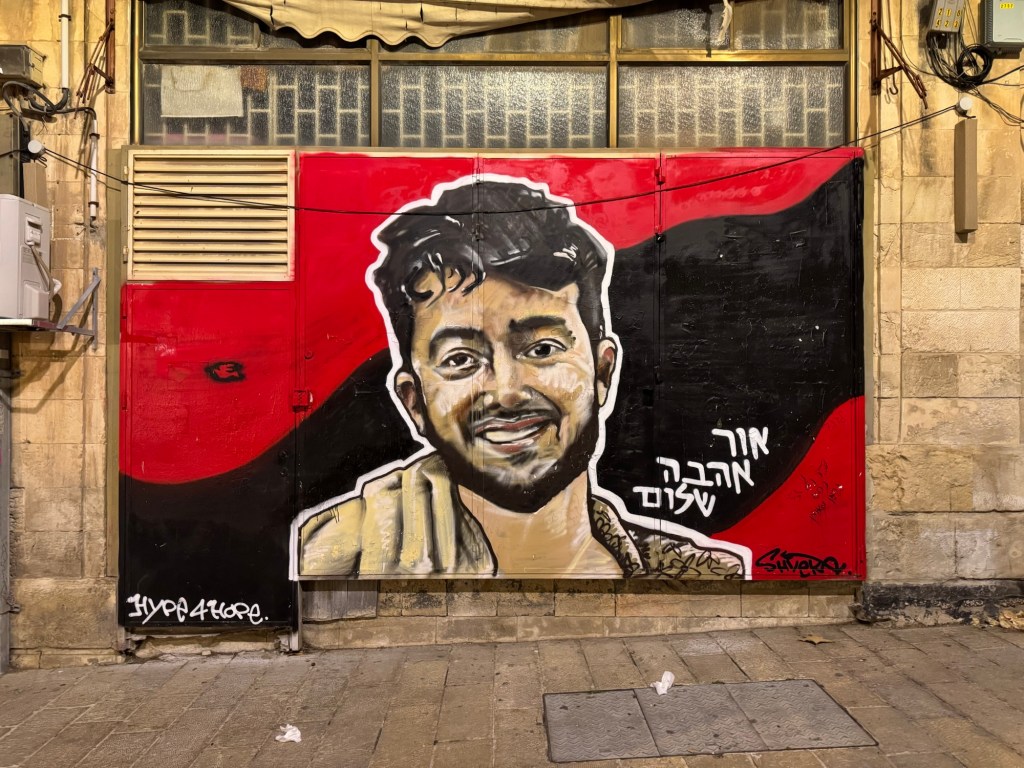
The past two years have had a shadow hanging over them. Every happy moment has had an asterisk.
Ever since we heard news of the kidnappings on October 7th, it was impossible to experience anything as purely good. How can you experience joy, or enjoy yourself, when you know that your family is in a literal dungeon?
This is partially why I haven’t written much here in the past couple of years.
Coming to Israel as a Jew you find that you are surrounded by family. Not unlike when you’re walking down the street of New York, or Paris, and you see someone wearing a kippa, or Star of David. You know that they’re your people. In Israel, it’s everyone.
On a very visceral level you get the sense that you’re everyone’s distant cousin, and treated as such. This doesn’t happen everywhere and all times, but it happens enough that you know it could happen anywhere or any time.
Whether it’s how you’re told off in the supermarket for (allegedly) cutting a line, or given a little something extra at a restaurant because “you’re skin and bones,” it’s the way people help each other. There’s a “sabra” way that it happens, a little prickly on the outside, but sweet underneath. It’s very much there as an undercurrent.
There’s a deeper level too, that this surface kinship was born from.
Whether Jews of European, Middle eastern, or African descent, everyone has the same holidays, and shares much of the same liturgy — even if their cultures hadn’t interacted in millennia. Everyone’s ancestors were outcasts and subjected to similar atrocities. Whether in Yemen or Poland, we were always the “other.”
Jews couldn’t own land, could only work in certain industries, had special taxes, certain places where they were allowed to live, and were always used as the scapegoat to distract from inequities and inequalities caused by poor or greedy governance.
In Israel, almost everyone around you are the descendants of refugees from every corner of the world, and you share that with them. The major difference between people is whether was it east or west, and in which of the three previous generations they were forced to become refugees.
There are exceptions—those who had lived in Israel for generations. Before the war of independence Jerusalem and Hebron were majority Jewish. My wife’s family are descendants of an old Jerusalemite family. But even those families were second class citizens in the Ottoman Empire — and previous empires, even in their homeland.
All this to say, that when we heard about the kidnappings, it didn’t matter if we knew the people personally, because we did know them, and they were our family.
Every moment I caught my mind wandering, it always wandered back to the hostages. Every day had a shadow over it, and every moment of joy had an asterisk.
Because how can you enjoy anything once you’ve heard the stories from the released hostages of the torture they were subjected to?
When they were returned I felt a weight lifted off my chest, and my soul. I felt like I could breathe for the first time in two years.
I have a confession to make. I didn’t understand the custom of the breaking of the glass at Jewish weddings. I thought I did, and intellectually I know all the explanations.
At the height of what is the most joyous and momentous moment of your life, you’re not allowed to enjoy it completely. Why would we do that?
Now I feel it viscerally, in my bones.
The destruction of the Temple itself was traumatic. The religion, and way of life, were centered around the Temple. The destruction of the Temple meant the end of the religion. The symbol of Judaism before the Star of David was the Menorah— the great candelabra of the Temple which was minted on the ancient Judean coins, and which the Roman Emperor Titus immortalized in Rome as the great symbol of his conquest of the Jews.
Three times a year people were supposed to make a pilgrimage to the Temple. Everyone met there, everyone prayed (and to this day, still pray) towards it. The Temple was the heart of our people. Its loss was catastrophic. It was only through great wisdom that the Rabbis were able to transform the religion in a way that held our people together throughout the millennia living in the diaspora.
That loss aside, the Roman invasion involved three weeks between the breaching of the walls of Jerusalem, and the destruction of the Temple. Three weeks of October 7ths, where the Roman soldiers raped and pillaged. Leading up to the breaching of the wall was a terrible siege. Each year on the 9th of Av we read stories of what happened during that siege and the following destruction — we do not forget. The stories of those atrocities alone would be enough to traumatize a people for all eternity.
It was because of that trauma that we break the glass, so even in our happiest moments we remember that loss.
So now I very much understand feeling that every joyous moment could be marred. If someone in your family has been kidnapped, you don’t stop thinking about them. You would move heaven and earth to get them home. That is not something you move on from until they are home.
There are still remains of victims held captive. My heart aches for their families, and for all the families of the victims of the war. I will not forget them.
I am so very grateful that the living hostages are home, our family is home, no one is living in a daily hell anymore.
I feel that now I can start to breathe again.
 Jack Reichert